

Bi-Directional Optical Transceivers
Available now for use at our LINX Manchester exchange.What is a Bi-Directional Optical Transceiver and How Does it Work
Bi-directional optical transceivers (or Bi-Di transceivers for short) allow the transmitting and receiving of data on a single fibre.
When connecting to the London Internet Exchange, most members will connect using a fibre pair or cross connect. One fibre is dedicated to receiving data from network equipment and the other is dedicated to transmitting data to the network.
Bi-Di optics split the light into different wavelengths using wavelength division multiplexers (WDM). They must work as a matched pair, with the correct receive and transmit wavelengths.
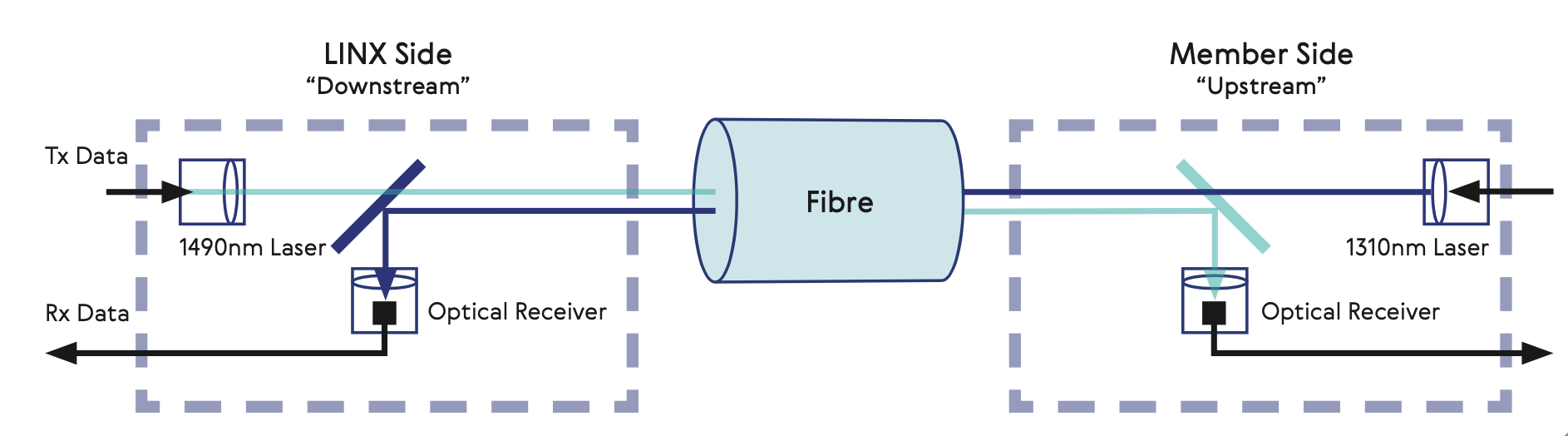
If you are interested in ordering a Bi-Di transceiver, please complete the new/upgrade portal form and tick the Bi-Directional Optic checkbox that appears when ordering at LINX Manchester.
Benefits of Bi-Directional Optics
The usual naming convention refers to one device as upstream and the other as downstream. For delivery of the LINX Bi-Di product, LINX will always be the downstream device. The member will need to purchase the corresponding upstream device.
The wavelengths of the Bi-Di transceivers are shown in the table below.
| Port Size | Member Side “Upstream” |
LINX Side “Downstream” |
| 10G | Transmit (nm) 1270 Receive (nm) 1330 |
Transmit (nm) 1330 Receive (nm) 1270 |
Bi-Di transceivers are currently only available for 10G ports, and there is no additional charge for use other than a £200 installation charge.
LINX Services Continued
Route Servers
The LINX multilateral route servers are provided to all members free of charge.
There are 2 of these servers on each of the LINX London peering LANs for additional resilience. Almost 65% of LINX members peer using this method advertising over 70,000 routes. LINX Manchester, LINX Scotland, LINX Wales and LINX NoVA also have route servers available to their members.
Route Collector
LINX operates a route collector on each Peering LAN powered by Alice & Birdwatcher
These serve primarily as a monitoring and troubleshooting tool for both LINX and our members. It is mandatory for each member to have a peering session with the collectors. Members can access the collector data through the looking glass service, that is accessible through our member portal.
Time Servers
The three Meinberg stratum 1 NTP Servers are available to all LINX members including those who are connected to LINX Manchester, LINX Scotland, LINX Wales and LINX NoVA.
The LINX stratum 1 time servers distribute high accuracy time, derived from a variety of time sources (GPS, DCF77 and MSF signals)
The servers are available for members to syncronise their own NTP servers with, which in turn provide a Stratum 2 NTP server for their internal network and customers (Rather than using the LINX NTP servers directly for every device/customer).