

Two diverse hubs across 17 data centres
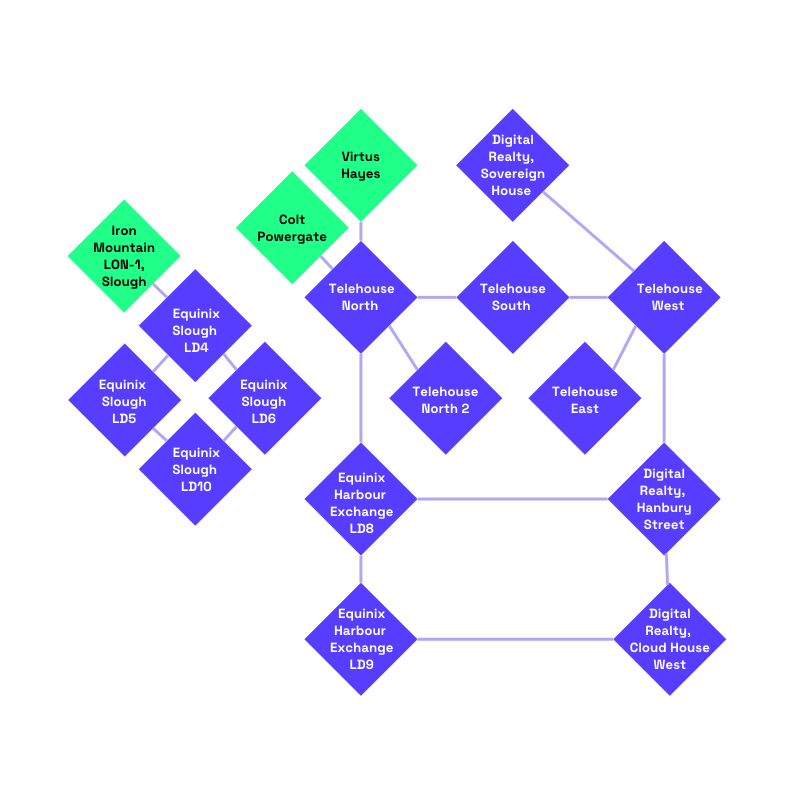
The original and largest LINX exchange
A high-performance Ethernet switching fabric on Juniper Networks hardware, accessible from 17 data centre locations across the city, including Equinix, Digital Realty and Telehouse.
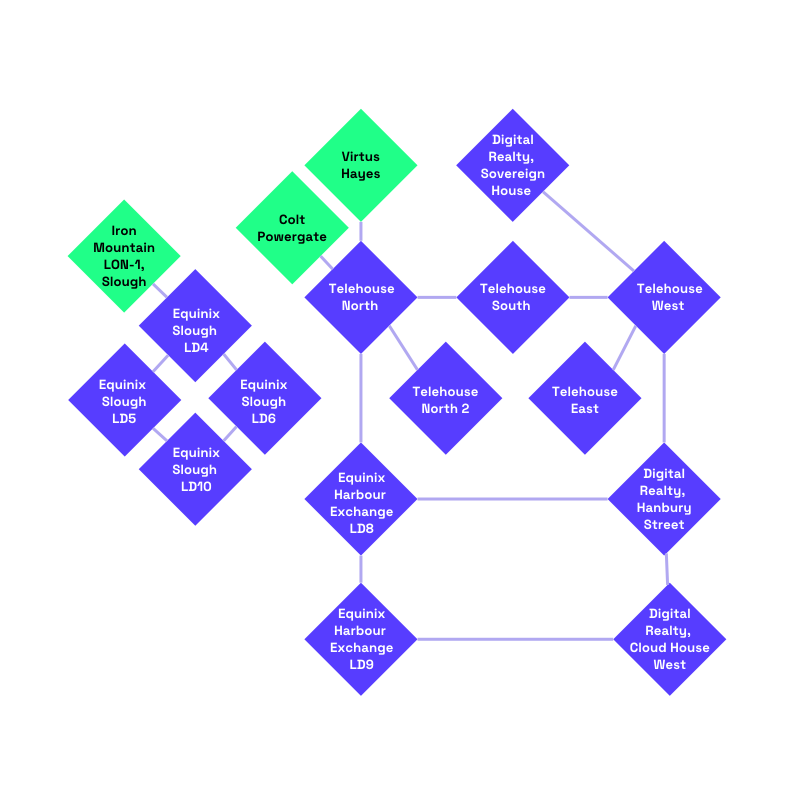
Resilient, redundant and ready for growth
Launched in the early 2000s and diverse from LON1, running Nokia IXR routers on SR-Linux with VXLAN-based EVPN. Traffic reroutes automatically, so LON2 complements LON1 for networks where uptime is non-negotiable.
Why networks connect in London
Built-in resilience
LON2 has no single point of failure. Traffic reroutes automatically, keeping your network connected when individual links or nodes encounter issues.
Redundancy across 17 locations
With 17 data centre locations across London, being present at more than one site gives you genuine diversity and strengthens your overall redundancy.
Lower latency, shorter paths
More direct routes and fewer hops, with traffic that stays local to keep performance high.
Greater control over routing
Deciding how your traffic flows means a stronger security posture and less exposure to DDoS attacks and other network-level threats.
Resilience across London
01
Run a service at LON1 — port access or peering bandwidth.
02
Add the exact same service at LON2.
03
The matched LON2 service is reduced by 60%. Port access and peering are assessed separately, so you can match one or both.
Port access matches at both sites, the peering does not.
| Service | LON1 | LON2 |
|---|---|---|
| Port access | 2x100GE | 2x100GE — matched |
| Peering | 150Gbps | 130Gbps — not matched |
LON2 cost: £224 for the matched port access (60% off £560), plus £1458 for the unmatched 130Gbps peering. Matching the peering at 150Gbps instead would cost £673.20 (60% off £1683), less than the £1458 unmatched fee.
Neither LON2 service matches LON1 yet, and matching both would reduce the bill.
| Service | LON1 | LON2 |
|---|---|---|
| Port access | 2x100GE | 1x100GE — not matched |
| Peering | 200Gbps | 100Gbps — not matched |
LON2 cost as shown: £280 port access plus £1122 peering, both at standard rates. Matching the port at 2x100GE costs £224 (60% off £560) and the peering at 200Gbps costs £897.60 (60% off £2244). Both come in below the unmatched fees.
A LON1 member is not yet on LON2 and adds the same capacity for built-in resilience.
| Service | LON1 | LON2 |
|---|---|---|
| Port access | 1x100GE | 1x100GE — add to match |
| Peering | 100Gbps | 100Gbps — add to match |
Adding both at LON2 to match: £560.80 per month, a 60% saving on the £1402 standard rate.
The 60% reduction on LON2 applies to exact match services only. Eligible services are port access and peering bandwidth. Direct member connections only, not valid for remote peering via a LINX ConneXions Reseller Partner. All figures shown are examples. Standard rates apply for services that are not matched, as set out on the service fees page.
Metro Resilience FAQs
A 60% reduction on port access and peering bandwidth at LON2 where you have a matched service at LON1.
LON1 and LON2 are diverse from one another, built on different hardware and software, so running matched services across both gives your network genuine dual-site resilience. The reduction applies to the LON2 services only, not to your total bill.
The ability to keep traffic flowing when part of your connectivity is disrupted. Rather than depending on a single connection, you spread traffic across more than one route, so if one is affected the other keeps you connected. Matched services across LON1 and LON2 give you a second independent path in London.
Port access and peering bandwidth. Match either or both across LON1 and LON2 to receive the 60% reduction at LON2.
Take a port access or peering service at LON1, then add a matched service at LON2. The matched LON2 service receives the 60% reduction.
It is a permanent reduction on matched LON2 services, not a limited-time promotion. The reduction continues to apply for as long as your services remain matched across LON1 and LON2.
No. Metro Resilience applies to direct member connections only.
Talk to the team about running the same services across LON1 and LON2, or start your application in the member portal.